

A Timeless Korean Game from Joseon to Seollal ✨
At Luna Hobby Store, we love celebrating hobbies that carry stories across generations.
공기놀이 (Gonggi Nori) is one of Korea’s most beloved childhood games. It has been played for centuries and remains a familiar sight during family gatherings such as Seollal and Chuseok.
Five small stones.
One steady hand.
A tradition that refuses to fade.
📜 The History of 공기놀이
The exact origin of 공기놀이 is unknown, but historical records confirm it has existed in Korea for centuries.
The word 공기 in this game is not related to the Sino-Korean word 공기 空氣 (Gong-gi) meaning “air.”
It is a completely different term.
In older Hangul, it was written as 공긔.
📖 A Joseon Dynasty Record

One of the most important references appears in:
《오주연문장전산고》 Ojuyeonmunjangjeonsango
(Oh-joo-yeon-moon-jang-jeon-san-go)
This encyclopedia was written by 이규경 李圭景 (Yi Gyugyeong) during the reign of King Heonjong in the 19th century.
In this text, the game is written as:
공기 拱棋 (Gong-gi)

The Hanja 拱棋 can be interpreted as “lifting game pieces.” Scholars debate whether this represents a true Sino-Korean term or whether the characters were borrowed for sound to represent an originally native Korean word.
Either way, the record confirms the game was already well established during the Joseon Dynasty.
👧 How the Game Was Described
The text describes a stone-throwing game called:
척석 擲石 (Cheok-seok)
It explains:

• A girl scatters about ten small stones
• She tosses one stone into the air
• Before it falls, she gathers two or three scattered stones
• She catches the falling stone in her palm
• She repeats until all stones are collected
The book specifically names this game 공기 拱棋 and notes that children commonly played with small stones in this way.
The mechanics are nearly identical to modern gonggi.
🍲 A Recorded Variation: 솥발공기 鼎足拱棋
The encyclopedia also documents a variation called:
솥발공기 鼎足拱棋 (Sot-bal Gong-gi)
“鼎足” refers to the three legs of a traditional cooking pot.
After catching stones, players would stack them into a tripod shape resembling pot’s legs.
This detail shows that structured variations of gonggi already existed during the Joseon period.
🌊 Regional Naming
In the Busan and Ulsan regions, the game is sometimes called:
살구 (Sal-gu)
Although it sounds identical to the Korean word for apricot, the meanings are unrelated.
🌏 A Wider Human Tradition
Like ancient knucklebone games found in:
🏺 Ancient Greece
🏛️ Ancient Rome
🐎 Central Asia
🇨🇳 China

Gonggi centers on timing and dexterity.
However, Korea developed its own distinct structure.
Unlike Western jacks, which use a bouncing rubber ball, traditional gonggi uses:
✔ Five small stones
✔ No external ball
✔ A pure toss-and-catch motion
Because it required nothing more than pebbles gathered from the ground, it became one of the most accessible children’s games across villages and schoolyards.
🎎 A Holiday Tradition

During Seollal and Chuseok, families gather to:
🍲 Share meals
🙏 Honor ancestors
👨👩👧👦 Spend time together
🎲 Play traditional games
While many think of Yutnori or Jegichagi, gonggi has long been a quieter indoor favorite.
It requires no board.
No setup.
No special equipment.
Grandparents teach the rhythm.
Parents cheer.
Children compete.
📺 Gonggi & the Squid Game Effect

When Squid Game premiered on Netflix, global audiences were introduced to traditional Korean children’s games.
Although gonggi was not one of the featured challenges, the series sparked curiosity about Korean playground culture.
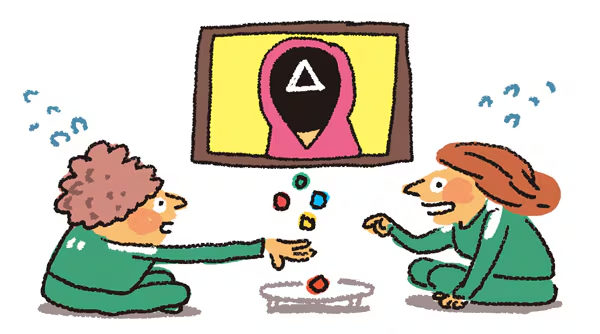
People began searching for:
“What is the Korean version of jacks?”
Tutorials resurfaced.
Cultural blogs revisited old traditions.
Gonggi quietly stepped back into global conversation.
A centuries-old game found new life in modern media.
🎮 How to Play 공기놀이

You will need:
🪨 5 stones
🖐️ One hand
📏 A flat surface
The game progresses in stages. Miss a catch and your turn ends.
🥇 Round 1 One by One
Scatter all five stones.
Pick up one stone.
Toss it into the air.
Grab ONE stone.
Catch the falling stone.
Repeat until all are collected.
🥈 Round 2 Two at a Time
Toss one stone.
Pick up TWO stones.
Catch the falling stone.
🥉 Round 3 Three and One
First toss, gather THREE stones.
Second toss, gather the remaining ONE.
🏅 Round 4 All Four
Toss one stone.
Pick up all FOUR remaining stones.
Catch the tossed stone.
👑 Final Round The Flip
Hold all five stones in your palm.
Toss them upward.
Catch as many as possible on the back of your hand.
Toss again and catch them in your palm.
Your score depends on how many stones you secure.
🎲 Modern Playground Variations
Over time, some traditional methods faded.
But children continued to invent new challenges.
These modern playground rules show how gonggi evolved through creativity and friendly competition.
🏟 운동장 (Wide-Leg Mode)
Play with both legs stretched wide apart and perform the game between them.
This limits movement and increases the physical challenge.
🚫 자리옮기기 (No Moving Your Spot)
Even if the stones land far apart, you are not allowed to move your body or shift position.
You must complete the round from where you started.
🍟 맥도날드 (M-Shape Sitting Mode)
Sit with both legs folded backward in an “M” shape while playing.
This position restricts balance and adds difficulty.
💥 까먹기 (Lose Your Points)
If you fail during the first stage, you lose all previously earned “age” points.
You must restart from zero.
🪨 징검다리 (Stepping-Stone Rule)
If stones are lined up neatly in a row, picking them up in order results in an automatic loss.
Players must avoid sequential grabs.
👀 눈높이 (No Looking Up Rule)
You are not allowed to look upward while tossing the stone.
This forces reliance on timing rather than visual tracking.
⏳ 삼 년 이상 (Three or More Rule)
During advanced flipping moves, if you catch fewer than three stones underneath, you lose the round.
This increases the difficulty in later stages.
📦 이삿짐 (Moving Day Rule)
If the stones land in a difficult position, you may move one stone to a different location before continuing.
A small mercy rule for tricky layouts.
🅿 주차장 (Parking Lot Rule)
If your hand is too small to hold all the stones at once, you may transfer them using the opposite hand.
A practical adjustment often used by younger players.
🌱 What These Variations Show
Gonggi is not frozen in history.
Children reshaped it.
They created challenge modes.
They adjusted rules to fit their playgrounds and personalities.
That creativity proves something important.
공기놀이 is not just a preserved tradition.
It is a game that adapts with each generation.
🌙 Why Gonggi Still Matters
🌙 Why Gonggi Still Matters
Across centuries of records and murals,
across family gatherings and playgrounds,
across classrooms and cultural revival,
공기놀이 endures because it is simple and human.
It represents:
✨ Skill without technology
✨ Play without expensive tools
✨ Memory passed hand to hand
All it takes is five stones and curiosity.
That is why it survives.
🌙 Bring Gonggi Home
At Luna Hobby Store, we celebrate hobbies that connect generations and prove that meaningful play does not need batteries or screens.
Ready to start your own game?
🪨 Grab your own Gonggi set here:
👉 Shop Gonggi Now
Practice your toss-and-catch.
Challenge your friends.
Teach the next generation.
Five stones.
One tradition.
Your turn.
Tag us and show your skills, Moon Clan 💛
#공기놀이 #Seollal #Chuseok #SquidGame #KoreanTradition #LunaHobbyStore